The billing codes that can slip through on a busy day — and why
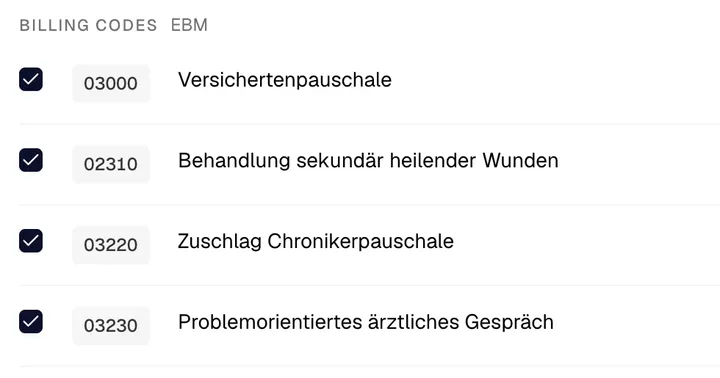
A forgotten billing code is not necessarily a knowledge problem. It can be a timing problem: the service ends, the next patient is waiting, and entering the code is the step that loses.
This is not about exotic items but about everyday ones whose conditions get lost on a full day: how long a conversation lasted, how often a patient came in the quarter, whether a chronically ill patient was cared for continuously. Since 1 July 2026 there is one more, which is new and therefore easy to miss: the care flat rate 03100. This overview follows the billing rules.
The overview
In the EBM, the fee schedule for statutory health insurance, a billing code (Ziffer) is called a Gebührenordnungsposition, or GOP. The GOPs below, all from everyday GP work, have one thing in common. Whether they can be billed depends on a condition that is easily lost on a full day: such as duration, number of contacts, interval, approval or, for 03100, diagnosis and medication.
| GOP | Service | What it requires | Value |
|---|---|---|---|
| 03230 | Problem-oriented consultation | Per completed 10 minutes; limited consultation volume per practice5 | 128 points · €16.31 |
| 03220 | Surcharge for treating chronically ill patients | Contact for the same chronic condition in at least three of four quarters, in person in at least one of them, in person or by video in another; 03220 itself requires an in-person contact4 | 130 points · €16.56 |
| 03221 | Add-on to 03220 | At least two in-person contacts in the quarter4 | 40 points · €5.10 |
| 03100 | Care flat rate (new since 1 July 2026) | Only diagnoses from a fixed list, one drug, contacts in three of four quarters; then replaces 03000 and 03220 to 032222 | 356 or 403 points · €45.36 or €51.34 |
| 02310 | Treatment of wounds healing by secondary intention | At least three doctor-patient contacts in the treatment case6 | 212 points · €27.01 |
| 01732 | Health check (check-up) | Once between the 18th and 35th birthday, every three years from 357 | 326 points · €41.53 |
| 35100 | Differential diagnosis of psychosomatic conditions | Only with approval for basic psychosomatic care9 | — |
New since July: the care flat rate 03100
Since 1 July 2026, the GP chapter of the EBM has a flat rate for chronically ill patients who need little care.12 It applies to patients aged 18 to 74 with exactly one chronic condition, treated with exactly one prescription drug. Two drugs with one prescription-only active ingredient each count as one if a combination product of exactly those two ingredients exists.2 Only diagnoses from a fixed list in four groups qualify: hypothyroidism and autoimmune thyroiditis, hyperlipidaemias and lipoprotein metabolism disorders, essential hypertension without hypertensive crisis and idiopathic gout. For the first billing, the patient must have had contact with the same practice for this condition in at least three of the last four quarters, including the current one, in person in at least two of them, and one of those may be a video consultation.2
- Half-yearly instead of quarterly. 03100 is billed once per treatment case and at most twice per illness case, never in two consecutive quarters. It pays for the half-year, whether the patient comes in one quarter or both.12
- Instead of, not on top of. It is billed instead of the per-patient flat rate 03000 and the chronic-care surcharges 03220 to 03222. In the following quarter, the same practice cannot bill 03000.2
- Add-on for intensive care needs. If the patient comes back in the following quarter, in person or by video, needing intensive care, the add-on 03110 can be billed: 152 points (€19.37) up to the 54th birthday, 173 points (€22.04) after that, for at most 8% of the cases in which the practice billed 03100 the quarter before.12
- Valued by age. 356 points up to the 54th birthday, 403 points after that.2
- All other chronic patients stay as they are. Anyone who doesn't meet the conditions is billed as before: 03000 and, where their conditions are met, 03220/03221. If one practice bills 03100, no other practice may bill 03220/03221 in that quarter or the next.2
Day to day, that means one more question for every chronic patient. Do they fit 03100, or do they stay on the chronic-care surcharge? The answer is in the documentation, in diagnosis and medication, but nobody reads it out of there while the next patient is waiting.
The conversation that ran long
The problem-oriented consultation 03230 is billed per completed ten minutes; a 25-minute conversation counts twice.5 It has to be a conversation the nature and severity of the illness require. General talk about an illness, legally required informed consent, preventive advice and talks that are part of another GOP, such as the per-patient flat rate or the chronic-care surcharge, do not count.5 Such a conversation happens in the middle of a full surgery, and ten honest minutes of conversation feel like care, not like a billable item. The documentation shows the conversation. The bill may not.
Two things decide. First, the documentation: KV Brandenburg recommends recording not only how long the talk took but also why the detailed talk was needed, so the billing can be backed up if questioned.5 Second, the consultation volume is limited: it is calculated at 64 points per treatment case in the practice, and that cap stays even after the GP budget was lifted.11 Since July, cases in which 03100 was billed the quarter before and there was an in-person or video contact in the current quarter also count towards it.2 A practice that doesn't enter its consultations leaves volume unused, and one that uses it all should know when.
The chronic patients everyone knows
03220 requires at least one contact for the same chronic condition in at least three of the last four quarters, including the current one: in person in at least one quarter, in person or by video in another. 03220 itself requires an in-person doctor-patient contact. The add-on 03221 needs at least two in-person contacts in the quarter.4 New since July: care also counts as continuous if 03100 was billed for the same condition two quarters earlier.2
With familiar patients especially, routine hides the item. The second in-person contact in a quarter is easy to forget when the first was only a prescription. The same mechanism catches the contract codes in GP-centred care (HzV): a second billing logic in the same surgery, with its own rules for each contract.
The wound the team looked after
Wound care is teamwork. But 02310 only becomes billable with at least three doctor-patient contacts in the treatment case.6 You can't see that condition in a single appointment. You see it only when someone counts the contacts at the end of the quarter, and that is exactly the step that goes missing on a long day.
The check-up that happened anyway
Statutory patients are entitled to the check-up 01732 once between their 18th and 35th birthday, and every three years from their 35th birthday. It is paid at a fixed price with no volume cap.7 Even so, it gets left behind when it happens alongside another concern and feels like part of the appointment rather than a service of its own.
The same goes for 35100, the differential diagnosis of psychosomatic conditions. It needs an approval that requires at least 80 hours of qualification in basic psychosomatic care.89 Whether the service then appears on the bill is another matter.
What really fixes the pattern
Not more training, because the knowledge is there. The fix is reading: every finished note, against every catalog, every day, with the doctor deciding. That is exactly what meda does. meda writes the documentation from the consultation, suggests the billing codes it supports, and shows the sentence that backs each suggestion. The doctor decides, and nothing enters your PVS unless you approve it.
- KBV: new care flat rate agreed with the GKV-Spitzenverband, practice news of 12 Mar 2026 (in German). kbv.de
- Bewertungsausschuss, 828th session: decision on the care flat rate (GOP 03100), 11 Mar 2026 (PDF, in German). kbv.de
- KV Bayerns: EBM overview of fee schedule items, Q4 2026, as of 5 Oct 2026 (PDF, in German). kvb.de
- KBV: chronic-care surcharge (in German). kbv.de
- KV Brandenburg: problem-oriented consultation, 29 May 2024 (in German). kvbb.de
- KV Westfalen-Lippe: notes on existing rules, updated 23 Jul 2026 (in German). kvwl.de
- KBV: check-up (in German). kbv.de
- KV Hessen: basic psychosomatic care, updated 10 Sep 2026 (in German). kvhessen.de
- KV Brandenburg: information on basic psychosomatic care, as of December 2021 (PDF, in German). kvbb.de
- Bewertungsausschuss, 803rd session: orientation value 2026, 17 Sep 2025 (PDF, in German). kbv.de
- KV Hamburg Journal 4/2026: what lifting the GP budget means for the consultation volume (in German). kvhh.net
The official text is authoritative. Not legal advice. All links accessed on 19 Oct 2026.
Questions doctors actually ask
Does 03100 replace the chronic-care surcharge?
Only for a narrowly defined group: patients aged 18 to 74 with only one chronic condition, and that one on the list of diagnoses, exactly one prescription drug for it (or two with one active ingredient each, if a combination product of exactly those two ingredients exists) and, for the first billing, contacts for this condition with the same practice in three of the last four quarters. Everyone else stays on 03000 and, where the conditions are met, 03220/03221.
How often can I bill 03230?
Per completed ten minutes, within the practice's consultation volume; beyond that volume the payment does not increase.11 The volume is calculated at 64 points per treatment case. KV Brandenburg recommends documenting not only the duration but also why the detailed talk was needed.5
Does this apply in GP-centred care (HzV) too?
No. In HzV, the billing codes and rules of the respective contract apply. This overview describes the EBM.
How much fee income do practices lose this way?
We'll publish that once we've measured it. A number before then would be an estimate, and there are enough estimates around.