How we measure: the method, published before the numbers
We publish the method before the numbers. That way you can check how a result was produced before it appears, and hold us to it.
What we measure
We will measure in normal practice operation, not on test cases. meda writes the documentation from the consultation, the doctor corrects it, and meda suggests the billing codes this documentation supports. For the measurement, every suggestion will be recorded with the decision that follows it, together with the sentence of the documentation it rests on.
So we don't measure what meda could find in theory, but what happens in the practice: which suggestions come up, which ones the doctor approves and which ones they don't.
The terms we count with
| Term | What it means |
|---|---|
| Suggestion | A billing code meda derives from the documentation of one contact, with the sentence that backs it. |
| Approval | The doctor confirms the suggestion. Only then does it go into billing. |
| Rejection | The doctor deletes the suggestion. It counts against us. |
| Approval rate | Approvals divided by all suggestions in the same period. |
| Approved suggestions | The number of suggestions the doctor approved. It does not show what would have been missing without meda. |
An approval rate is not a completeness rate. It says how often doctors approve our suggestions, not how much fee income a practice is missing overall. That's why we don't call it one.
What counts and what doesn't
- Only a billing code the documentation supports and the doctor approved counts as an approved suggestion.
- Rejected suggestions are in the result, not in a footnote.
- No projection to a full year, no hand-picked best cases, no euro totals built on assumptions.
- No number before the measurement is complete.
Why the rejection matters most
A suggestion the doctor rejects will be the most important data point we collect. It shows where a suggestion was wrong. This is exactly where the doctor decides whether the documentation supports the billing code. Because every billing code only goes into billing after approval, the measured result is only what doctors decided was correct. Nothing enters your PVS unless you approve it.
Why this matters for the KV's review
The regional association of statutory health insurance physicians (KV) checks doctors' billing for plausibility, above all the volume of services billed per day against the doctor's time.1 For this, many EBM services carry a review time (Prüfzeit). If the time calculated from the review times exceeds twelve hours in the daily profile on at least three days in a quarter, or 780 hours in the quarterly profile, for a full-time licence, further checks follow.2
Billing in full what is documented also raises the time profile for services that carry a review time. Every approved billing code stays linked in meda to the documentation it came from.
What gets published
The method and the approval rates. When the results publish, they publish in full, including where they speak against us. Until then, this page is the promise you can hold us to.
- Social Code Book V (SGB V), § 106d, billing review in statutory care, para. 2 (in German). gesetze-im-internet.de
- KBV and GKV-Spitzenverband: Abrechnungsprüfungs-Richtlinien (billing review guidelines under § 106d(6) SGB V), § 8(1) and (4), version of 20 May 2020 (PDF, in German). kbv.de
The official text is authoritative. Not legal advice. All links accessed on 19 Oct 2026.
Questions doctors actually ask
When do the results come out?
After the measurement. We deliberately give no date: the method is already public, and the numbers publish once the measurement is complete.
Why don't you give a euro figure?
Because any euro figure before the measurement ends would be a projection. What a practice bills in addition depends on its specialty, its mix of services and its documentation.
Does a rejection really count against meda?
Yes. Every suggestion goes into the approval rate, including the rejected ones. A result that only showed the hits would say nothing about the method.
Related articles
Honorarausschöpfung: billing everything you already documented
What is documented but not billed, and what legitimately closes the gap.
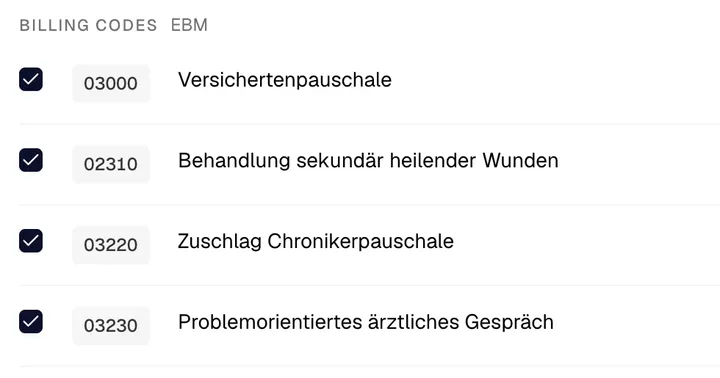
The billing codes that can slip through on a busy day — and why
The condition behind each code, and why it can slip through on a busy day.
GOÄneu: what changes for your private billing
What the draft changes for your private billing, and where the reform stands.